 Style
Style
Space Invader Paris: complete guide to the mosaics, the game and the hunt
Par Gabriel Goldberg
1 September 2026
13 min read
More than 1,500 Space Invader mosaics in Paris. The story of the artist Invader, how the FlashInvaders app works, Paris versus other cities worldwide, his studio, the spin-off games and the artists he inspired.
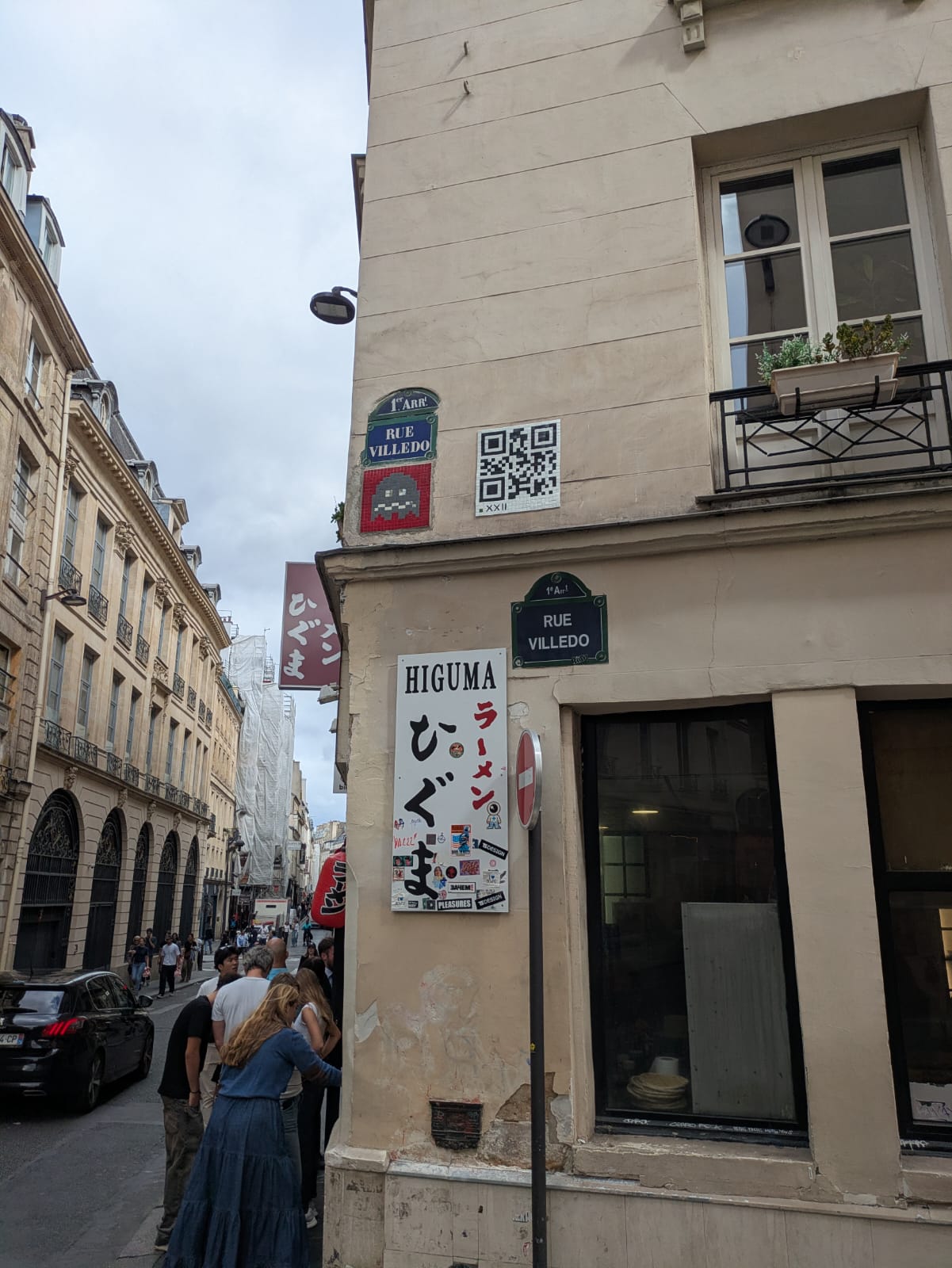
You don't look for Space Invaders — you start seeing them. Once the eye has learned, Paris changes nature. A street corner, a blue enamel sign, a peeling façade above a shopfront, and there, four metres up, a twenty-centimetre tiled creature is looking back at you. There are more than 1,500 in Paris alone. It is the largest scattered artwork ever installed in a city, and almost nobody looks up. Corner of rue Villedo in the 1st arrondissement of Paris: below the enamel street sign, a red tiled mosaic of a Pac-Man ghost next to a QR code also made of tiles, above the sign of the Higuma ramen restaurant and a queue of customers on the pavement. Key facts: Invader is an anonymous French artist who, since 1998 , has been cementing ceramic-tile mosaics inspired by the 1978 arcade game Space Invaders onto city walls. Paris is his home city: more than 1,500 pieces have been installed here, out of roughly 4,000 across more than 80 cities and some thirty countries. Every mosaic scores points in the official FlashInvaders app, which turns the city into a photographic treasure hunt. What is visible today is only a fraction of the total: around half has been stolen, prised off or lost to building works. 1. Who Invader is — and why nobody knows his face He appears masked, with his voice altered, under a pseudonym. We know he was born in 1969, studied at the Beaux-Arts in Paris, and installed his first mosaic in the city in 1998 . The rest is deliberately blurred: the anonymity is not a…