 Style
Style
Swiss vs Japanese watchmaking: history, movements, groups
Par Gabriel Goldberg
10 September 2026
16 min read
Why Switzerland and Japan are the world's only complete watchmaking ecosystems: hairsprings, escapements, quartz, automatics, perpetual calendars, Swatch Group, Richemont, LVMH, Seiko, Citizen, Rolex. A long, documented guide.
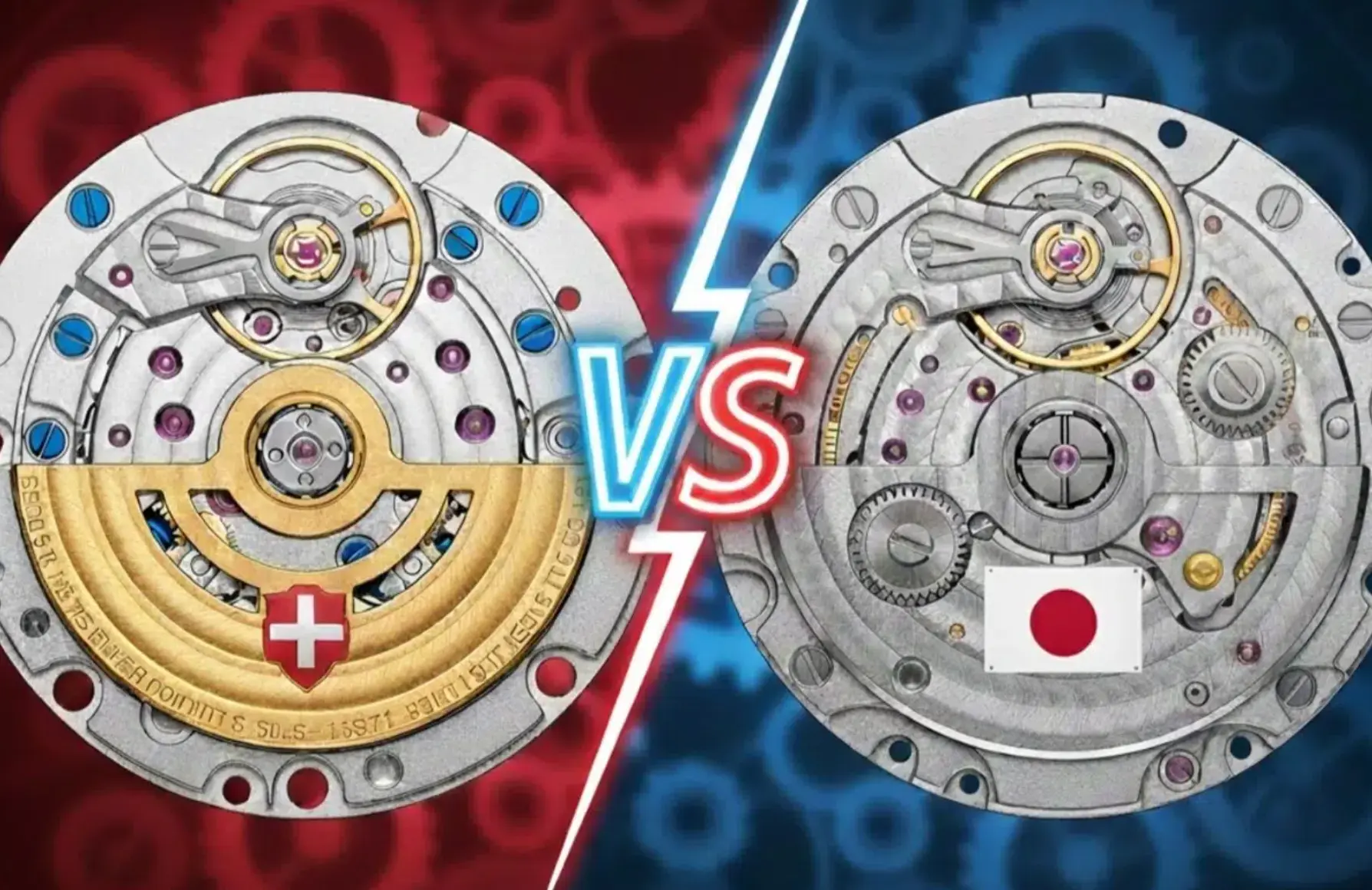
A mechanical watch has between 130 and 400 parts. Any country can design one, assemble one, sell one. But only two on earth can manufacture all of those parts at home: Switzerland and Japan. That apparently trivial sentence explains almost everything you see in a shop window — the prices, the conglomerates, the collaborations, and why a superb French or British house so often hides a Japanese movement under its dial. Two automatic movements side by side, a Swiss calibre with a gilded oscillating weight on a red background on the left and a Japanese calibre with steel finishing on a blue background on the right, split by a white lightning bolt and the letters VS. The short answer: Switzerland and Japan are the only two countries with a complete watchmaking ecosystem — able to produce in-house the critical components: hairspring , escapement , mainspring , jewels , lubricants , quartz oscillator , dials , cases and bracelets . Switzerland built that autonomy over three centuries of craft and industrial consolidation ( Swatch Group , Richemont , LVMH , Rolex ); Japan built it in forty years of vertical integration ( Seiko , Citizen , Casio ). The result: most fine French, British, German or American brands buy their engines from these two countries — very often from Japan's Miyota (Citizen group) or Switzerland's Sellita . 1. What a "complete ecosystem" actually means People imagine a manufacture as a pretty workshop where bridges get screwed down. Reality is harsher. Inside a…